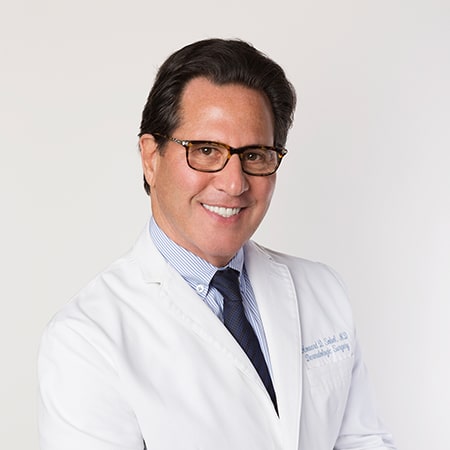
Board-Certified Dermatologic Cosmetic Surgeon · New York Magazine Best Doctor, 21 consecutive years
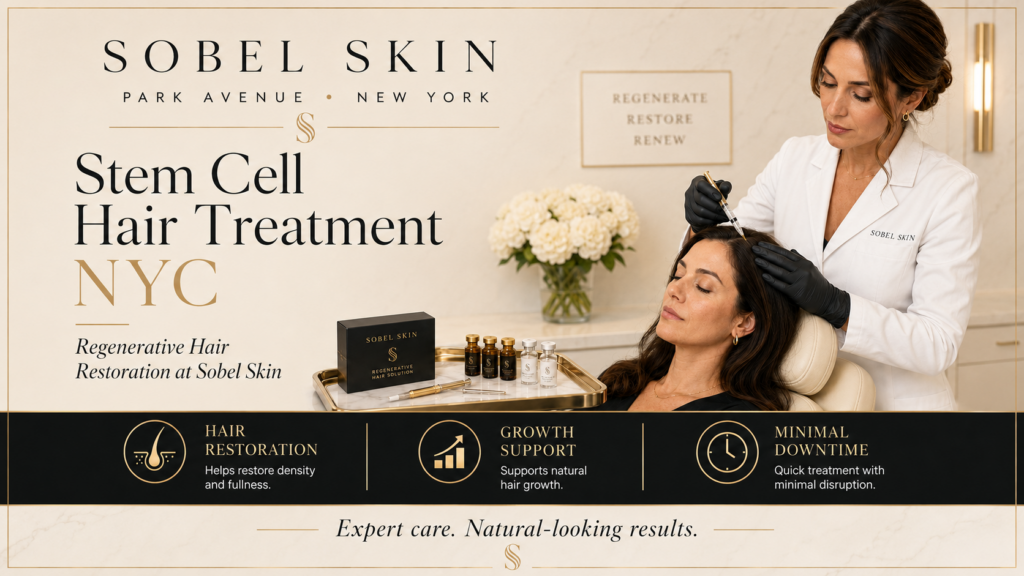
Of all the options in modern hair restoration, a stem cell hair treatment in NYC is the one that reaches deepest into regenerative medicine — using your body’s own master repair cells to rebuild what pattern hair loss has been quietly dismantling. It’s also the treatment surrounded by the most hype and the least clear explanation online. Here’s an honest walkthrough of how stem cell hair restoration at Sobel Skin actually works, who it’s designed for, and where it fits among the alternatives.
The Science: What Stem Cells Do for Hair Follicles
Mesenchymal stem cells are the body’s regenerative specialists — undifferentiated cells capable of supporting repair in damaged tissue. In hair restoration, they’re derived from the patient’s own adipose (fat) tissue, which is one of the richest and most accessible sources of these cells in the body.
The prepared stem cell solution is applied to the scalp, where the cells go to work on the follicles that pattern hair loss has been shrinking: repairing damaged follicle structures, improving the local environment with new blood supply signaling, and stimulating dormant follicles back into active growth phases. The treatment doesn’t paste anything on — it works at the biological root of the problem, using the body’s own regenerative machinery.
Who Stem Cell Hair Restoration Is Really For
This is the most important section of this article, because stem cell therapy is not the universal first choice — it’s the specialist’s tool:
• More established thinning — patients whose loss has progressed beyond the earliest stages, where maximum regenerative firepower matters
• PRP non-responders — patients who completed a PRP series with underwhelming results and need a different mechanism
• Patients maximizing every avenue — often combined with other modalities in a comprehensive protocol
• Both men and women with pattern loss, evaluated case by case
For early-stage thinning, gentler options usually come first — Alma TED or PRP frequently deliver excellent results without escalating. Part of an honest evaluation is being told you don’t need the most advanced treatment in the building.
The Treatment Experience
The process involves harvesting a small amount of adipose tissue, preparing the stem cell solution, and applying it to the treatment areas of the scalp — a meticulous process performed in-office. Downtime is minimal: expect some tenderness at the harvest site and mild scalp sensitivity for a few days, with normal routines resuming quickly.
Treatment frequency is individualized — unlike the fixed three-session protocols of other options, the plan depends on your degree of loss, response, and whether stem cell therapy is working solo or anchoring a combination program.
The Results Timeline: Patience, Then Payoff
Months 1–2: The regenerative process works invisibly; shedding may slow as follicles stabilize.
Months 2–4: New growth emerges — fine hairs first, gaining caliber over time.
Months 4–6+: Density improvement becomes clearly visible; results continue maturing well past the six-month mark.
Regenerative treatments run on biological time — slower to show than a filler, built to last in a way surface treatments never are. Results can hold for several years, with maintenance recommended to protect gains against the ongoing background process of pattern loss.
Where It Fits: The Complete Hair Restoration Picture
Sobel Skin’s hair program spans three tiers — needle-free Alma TED, workhorse PRP, and regenerative stem cell therapy — detailed side by side in our complete hair loss treatment comparison. The tiered structure is the point: your evaluation determines the entry point, and escalation happens only if your follicles ask for it. One constant across all three: earlier is better. Every option revives struggling follicles; none resurrects long-dead ones.
Frequently Asked Questions
Does stem cell hair treatment really work?
For appropriate candidates — established thinning with viable follicles — stem cell therapy can meaningfully improve density and follicle health, particularly where simpler treatments underperformed. Candidacy assessment is everything, which is why treatment begins with an evaluation, not a package sale.
How much does stem cell hair treatment cost in NYC?
It’s the most intensive option in the program and priced accordingly, individualized to your protocol. You’ll receive an exact plan and quote at consultation before any commitment.
Is the treatment painful?
It’s well tolerated — the harvest involves local anesthetic, and post-treatment effects are limited to a few days of mild tenderness.
How long do results last?
Results can last several years, with periodic maintenance recommended — hair loss is a progressive condition, and protecting regenerative gains is part of the long-term plan.
Stem cells vs. PRP — what’s the difference?
PRP concentrates growth factors from your blood; stem cell therapy deploys actual regenerative cells from your adipose tissue — a deeper mechanism suited to more established loss. They’re sequential tools more often than competitors: PRP first for many, stem cells when more is needed.
Find Out Which Tier Your Hair Needs
The right starting point is a scalp evaluation with Dr. Howard Sobel‘s team at 960 A Park Avenue. Explore stem cell hair restoration, call 212.288.0060, or schedule a consultation online.
Sobel Skin is a premier aesthetic dermatology practice serving the Upper East Side, Manhattan, and the greater New York area.