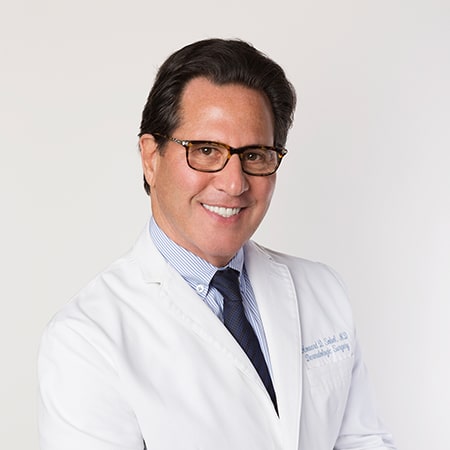
Board-Certified Dermatologic Cosmetic Surgeon · New York Magazine Best Doctor, 21 consecutive years
If you’ve started researching hair loss treatment in NYC, you’ve probably discovered the problem isn’t finding options — it’s making sense of them. PRP, exosomes, stem cells, lasers, needle-free devices: every practice promotes something different, and most explain almost nothing about how they compare. This guide breaks down the three non-surgical treatments offered at Sobel Skin’s hair restoration program on Park Avenue — Alma TED, PRP, and stem cell therapy — including who each one suits best and what results realistically look like.

One thing worth saying upfront: the single biggest factor in hair restoration success isn’t which treatment you choose. It’s how early you start. Every option below works by reviving struggling follicles — none can resurrect follicles that have been dormant for years. If you’re noticing thinning now, now is when treatment works best.
Why Hair Thinning Happens
The most common cause by far is androgenetic alopecia — pattern hair loss — which affects the majority of men and, by some estimates, roughly half of women over their lifetimes, according to the American Academy of Dermatology. Hormonal shifts, stress, nutritional deficiencies, and postpartum changes also play major roles, particularly in women. Because the cause shapes the treatment plan, every hair restoration patient at Sobel Skin starts with an evaluation by Dr. Sobel — not a sales menu.
Hair Loss Treatment NYC Patients Ask About Most: The Three Options
Alma TED: Needle-Free, No-Downtime Restoration
Alma TED (TransEpidermal Delivery) is the newest of the three and the one patients are most curious about — largely because it involves no needles at all. The device uses ultrasound-based acoustic sound waves and air pressure to open microchannels in the scalp, then drives a growth-factor and peptide serum deep into the follicle level. Most patients describe it as a warm scalp massage.
A typical protocol is three monthly sessions. Shedding often slows within the first month, with visible improvement in thickness and density building over two to three months. There is zero downtime — you can come in at lunch and go back to work.
Best for: early to moderate thinning, needle-averse patients, and anyone who wants to start treatment without any recovery window.
PRP: The Proven Workhorse
Platelet-rich plasma has the longest clinical track record of the three. A small blood draw is spun in a centrifuge to concentrate your platelets — the cells packed with growth factors — and that concentrate is injected directly into the areas of thinning. The growth factors stimulate follicles, extend the growth phase of the hair cycle, and improve density over a series of sessions.
PRP for thinning hair typically starts with three to four monthly sessions, then maintenance once or twice a year. Because it uses your own blood, there’s nothing synthetic to react to.
Best for: patients who want the most studied option, and those with early to moderate pattern loss in both men and women.
Stem Cell Therapy: The Regenerative Frontier
Stem cell hair restoration uses mesenchymal stem cells derived from the patient’s own adipose (fat) tissue, prepared into a solution and applied to the scalp to repair damaged follicles and stimulate new growth. It’s the most intensive of the three approaches and draws on the same regenerative medicine principles used across modern dermatology.
Best for: patients with more established thinning, or those who haven’t responded fully to PRP alone.
Side by Side: How the Three Compare
| Alma TED | PRP | Stem Cell | |
|---|---|---|---|
| Needles | None | Injections | Extraction + application |
| Downtime | None | Minimal (1 day of scalp tenderness) | Minimal |
| Typical starting protocol | 3 monthly sessions | 3–4 monthly sessions | Individualized |
| First visible results | 4–8 weeks | 2–3 months | 2–4 months |
| Ideal candidate | Early–moderate thinning, needle-averse | Early–moderate pattern loss | Established thinning, PRP non-responders |
The Real Answer: Combination Protocols
Here’s what most articles won’t tell you: at a practice that offers all three, the question is rarely “which one” — it’s “in what combination and sequence.” Alma TED and PRP work through complementary mechanisms, and many of Dr. Sobel’s patients get their best results pairing them: PRP delivering concentrated growth factors by injection, Alma TED driving additional growth factors follicle-deep between sessions without adding needle fatigue.
This is the advantage of seeking hair loss treatment at a medical dermatology practice rather than a single-device clinic: when a provider only owns one tool, every patient gets that tool. When the full toolkit is available, the plan is built around your scalp, your stage of loss, and your tolerance — not around the equipment.
Frequently Asked Questions
Which hair loss treatment works best?
The honest answer: the one matched correctly to your stage and cause of hair loss, started early, and followed consistently. PRP has the deepest research base; Alma TED delivers the easiest patient experience with strong early results; stem cell therapy offers the most regenerative potential for advanced cases. The evaluation determines the ranking for you.
How much does hair loss treatment cost in NYC?
Each treatment is priced per session, and combination plans are tailored to the individual. After your consultation and scalp evaluation, you’ll receive an exact protocol and quote before committing to anything.
Do these treatments work for women?
Yes — all three are used for female pattern hair loss, postpartum shedding, and stress-related thinning. Women make up a substantial share of hair restoration patients at Sobel Skin, and early treatment is just as important for women as for men.
How long do results last?
Hair restoration is ongoing management of a progressive condition, not a one-time cure. After the initial series, most patients maintain results with one to two sessions per year. Stopping treatment entirely allows the underlying hair loss process to resume over time.
Will I need a hair transplant instead?
Not necessarily — and the goal of starting non-surgical treatment early is precisely to avoid ever needing one. For follicles that are miniaturizing but still alive, these treatments can restore density. If loss is too advanced, Dr. Sobel will tell you honestly rather than sell you sessions that can’t deliver.
Start Your Hair Loss Treatment in NYC at Sobel Skin
Sobel Skin’s hair restoration program is led by Dr. Howard Sobel at 960 A Park Avenue on the Upper East Side. If your hair is thinning, the best time to act is before it progresses further. Explore the full hair loss treatment program, call 212.288.0060, or book a consultation online.
Sobel Skin is a premier aesthetic dermatology practice serving the Upper East Side, Manhattan, and the greater New York area.