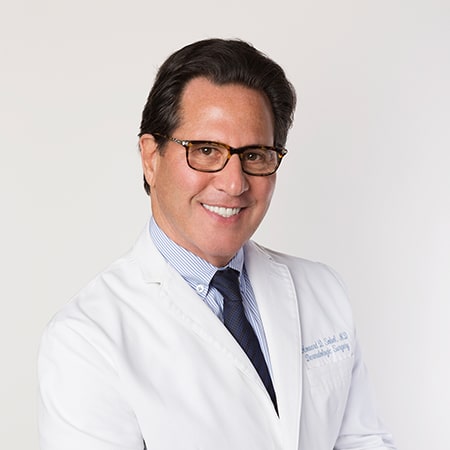
Board-Certified Dermatologic Cosmetic Surgeon · New York Magazine Best Doctor, 21 consecutive years
If you live or work on the Upper East Side, you’re never more than a few blocks from someone offering Botox. Medspas, salons, and even dental offices have added injectables to their menus. That abundance is exactly why choosing where to go has become the hardest part of the process — because with Botox, the product is identical everywhere. The result is not. The difference is entirely in the hands holding the syringe.
At Sobel Skin, Botox treatments on the Upper East Side are performed under the direction of Dr. Howard Sobel, a board-certified dermatologic cosmetic surgeon who has been named a New York Magazine Best Doctor for 21 consecutive years. His Park Avenue practice has been treating Upper East Side patients for decades — many of whom have been returning for that entire span. Here’s what a first visit actually looks like, and what to expect at every stage after.
First, What Botox Actually Does
Botox is a purified neurotoxin (botulinum toxin type A) that temporarily relaxes the small facial muscles responsible for expression lines — the vertical “11s” between the brows, horizontal forehead creases, and crow’s feet around the eyes. When those muscles stop contracting at full strength, the skin above them stops creasing, and existing lines soften.
What Botox does not do is fill, lift, or add volume — that’s the job of dermal fillers, which address a different kind of aging entirely. Many patients benefit from both, but they are not interchangeable, and a good consultation begins by clarifying which one your concerns actually call for.
The Consultation: Where the Result Is Actually Determined
The best Botox result is decided before the first injection. During your consultation at our Park Avenue office, Dr. Sobel evaluates how your face moves — not just where lines sit at rest, but how your muscles fire when you speak, smile, and raise your brows. Facial anatomy varies enormously from person to person: brow shape, muscle strength, asymmetries you’ve likely never noticed. A dosing pattern copied from a chart produces the frozen, “done” look; a dosing pattern built from your anatomy produces a face that looks rested rather than treated.
This is also where product selection happens. Sobel Skin carries all four FDA-approved neurotoxins — Botox, Dysport, Xeomin, and Jeuveau — which means the recommendation is based on what suits your anatomy and history, not on what the practice happens to stock. Patients who’ve felt a previous product wore off too quickly, or kicked in too slowly, often do better on an alternative.
The Treatment Itself: Faster Than Your Coffee Order
The appointment is brief — the injections themselves typically take about ten minutes. Botox is administered with an ultra-fine needle, and most patients describe the sensation as a series of small pinches. Topical numbing is available but rarely requested.
There’s no downtime in any meaningful sense. You can return to work, lunch, or the rest of your day immediately. The aftercare rules are simple: stay upright for a few hours, skip strenuous exercise until the next day, and don’t rub or massage the treated areas — you want the product to stay precisely where it was placed.
The Results Timeline
Botox is not instant, and knowing the timeline prevents unnecessary worry:
Days 1–3: Little to no visible change. This is normal.
Days 3–7: The muscles begin to relax, and lines start softening. Most patients notice the shift somewhere in this window.
Day 14: Full effect. This is when the result should be judged — and when any fine-tuning touch-up would be considered, never earlier.
Months 3–4: The effect gradually fades as nerve endings regenerate. Movement returns slowly and naturally — lines don’t snap back overnight.
Most patients settle into a maintenance rhythm of three to four visits per year. Interestingly, with consistent treatment, many find the intervals stretch longer over time, as the treated muscles weaken slightly from reduced use.
Why the Injector Matters More Than the Brand
Everything that can go wrong with Botox — a heavy brow, a droopy lid, an asymmetric result, the frozen look — is a placement or dosing error, not a product failure. This is why the medspa-versus-medical-practice distinction matters. A physician who has spent decades studying facial anatomy is working with a fundamentally different depth of knowledge than a technician who completed a weekend certification course.
There’s also the question of judgment: knowing when less is the right answer, when Botox isn’t the right tool at all, and how to plan treatment so it ages gracefully with you over the years rather than looking impressive for one photo. That long-view approach is a large part of why so many of Dr. Sobel’s Botox patients have been with the practice for ten, fifteen, or even twenty years.
Frequently Asked Questions
How much does Botox cost on the Upper East Side?
Pricing is typically per unit, and the number of units depends on your anatomy, the areas treated, and your muscle strength. Rather than quoting a misleading flat number, we provide an exact treatment plan and cost at your consultation — before anything is injected.
Will people be able to tell I’ve had Botox?
Done well, no — they’ll notice you look rested, not treated. The telltale signs people associate with Botox (the shiny frozen forehead, the surprised arch) are signs of over-treatment, which is precisely what conservative, anatomy-based dosing avoids.
Is Botox safe?
Botox has been FDA-approved for cosmetic use since 2002 and is one of the most studied aesthetic treatments in the world. In the hands of an experienced physician injector, side effects are typically limited to minor, short-lived redness or bruising at the injection points.
How old should I be to start Botox?
There’s no single right age — it depends on when dynamic lines begin bothering you. Some patients start preventatively in their late twenties or thirties, before lines etch in at rest; others begin in their fifties. The consultation determines whether Botox is the right tool for what you’re seeing in the mirror.
Botox vs. Dysport vs. Jeuveau — how do I choose?
You don’t have to — that’s the injector’s job. All are botulinum toxin type A and perform similarly in studies, with subtle differences in onset speed, spread, and duration between individuals. Because Sobel Skin carries all four neurotoxins, Dr. Sobel matches the product to you rather than defaulting to a house brand.
Visit Sobel Skin on Park Avenue
Sobel Skin is located at 960 Park Avenue, in the heart of the Upper East Side. If you’re considering Botox for the first time — or you’ve had it elsewhere and want a more refined result — schedule a consultation with Dr. Howard Sobel and his team. Call 212.288.0060 or book online.
Sobel Skin is a premier aesthetic dermatology practice serving the Upper East Side, Manhattan, and the greater New York area.