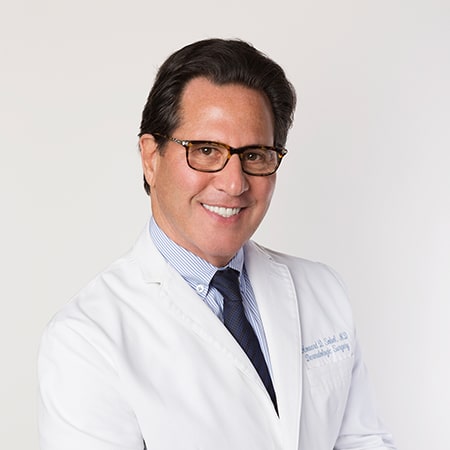
Board-Certified Dermatologic Cosmetic Surgeon · New York Magazine Best Doctor, 21 consecutive years
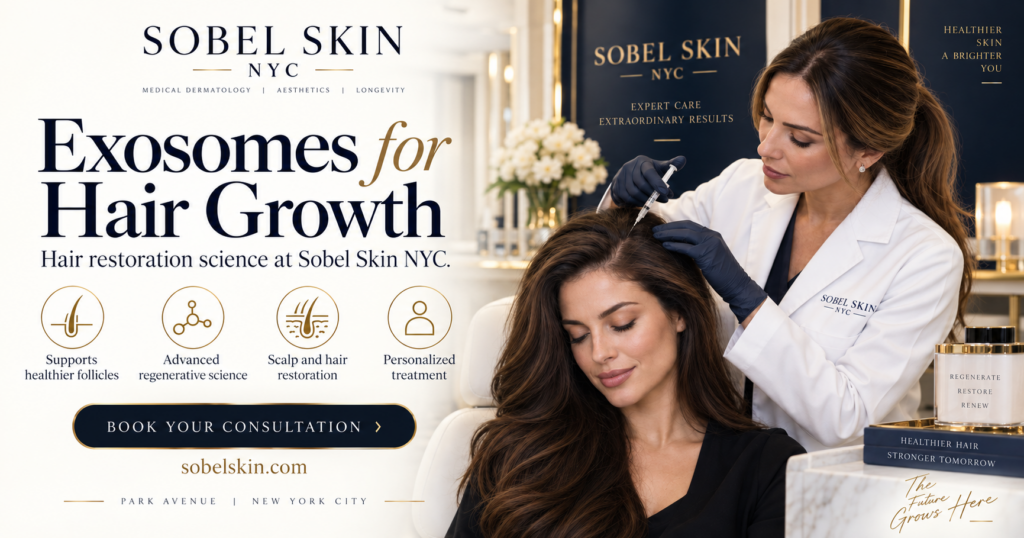
Exosomes for hair growth are having a moment — the word is everywhere in aesthetics right now, promised as the next breakthrough in hair restoration. Some of the excitement is warranted, and some is marketing running ahead of the science. As a dermatology practice built on evidence rather than hype, Sobel Skin thinks patients deserve the honest version. Here’s what exosomes actually are, what the science does and doesn’t yet show, and how they fit into real hair restoration.
What Exosomes Actually Are
Exosomes are tiny vesicles — microscopic packages that cells release to communicate with one another. They carry growth factors, proteins, and genetic signaling material, essentially acting as messengers that tell other cells what to do: repair, regenerate, grow. In the context of hair, the theory is compelling: exosome signaling may encourage dormant follicles back into active growth and support the follicle environment.
That’s a genuinely exciting mechanism — and the reason exosomes have drawn serious scientific interest across regenerative medicine, not just hair.
The Honest Science: Promising, Still Early
Here’s the part the marketing often skips. Exosome therapy for hair is promising but still an emerging area — early research and clinical experience are encouraging, but the large, long-term studies that establish a treatment as a proven standard are still developing. It’s also worth knowing that exosome products are not yet FDA-approved as hair loss drugs; they occupy a newer, less-regulated space than long-established treatments.
None of that means exosomes don’t work — it means an honest practice presents them as a cutting-edge option with growing support rather than a guaranteed miracle. Anyone promising the moon from exosomes alone is ahead of the evidence.
How Exosomes Fit Into Real Hair Restoration
In practice, the most grounded use of exosome signaling is as part of a combination approach rather than a stand-alone cure. This is exactly where a treatment like Alma TED comes in — its growth-factor and peptide serum, driven to the follicle level by ultrasound, delivers regenerative signaling compounds without needles, and it’s one of the most established ways to get that category of benefit to the follicle. Paired with the proven mechanisms of PRP and, for advanced cases, stem cell therapy, the result is a plan built on what’s established, enhanced by what’s emerging.
The full breakdown of Sobel Skin’s evidence-based hair options is in our complete hair loss treatment comparison.
The Rule That Never Changes
Whatever the newest technology, one principle governs all hair restoration: it revives struggling follicles, never dead ones — so starting early remains the single biggest predictor of success. The most advanced exosome protocol can’t regrow hair from follicles that quit years ago. If you’re thinning now, now is the treatment window, whatever combination of tools your plan ultimately uses.
Frequently Asked Questions
Do exosomes really work for hair growth?
The mechanism is promising and early results are encouraging, but exosome therapy is still an emerging area without the large long-term studies that establish a proven standard. It’s best viewed as a cutting-edge option within a combination plan — not a stand-alone guaranteed cure.
Are exosomes better than PRP?
They work differently — PRP uses your own concentrated platelets and has a far deeper track record; exosomes are newer signaling therapy. Rather than either/or, the strongest plans combine established treatments with emerging ones based on your needs.
Are exosomes FDA-approved for hair loss?
Exosome products are not currently FDA-approved as hair loss treatments — they occupy a newer, less-regulated space. An honest consultation will tell you where any treatment stands regulatorily.
How do I know which hair treatment is right for me?
A scalp evaluation determines your cause and stage of loss, then matches treatments accordingly — often a combination. The goal is a plan built on evidence, not on whatever’s trending.
Is it too late for me to treat hair loss?
If follicles are thinning but still active, no — that’s the ideal window. Where the scalp has been smooth for years, those follicles are gone. The evaluation tells you honestly which situation you’re in.
An Evidence-Based Plan for Your Hair
Skip the hype and get a plan built on what actually works for your stage of hair loss. Book with Dr. Howard Sobel‘s team at 960 A Park Avenue: explore the hair restoration program, call 212.288.0060, or schedule a consultation online.
Sobel Skin is a premier aesthetic dermatology practice serving the Upper East Side, Manhattan, and the greater New York area.