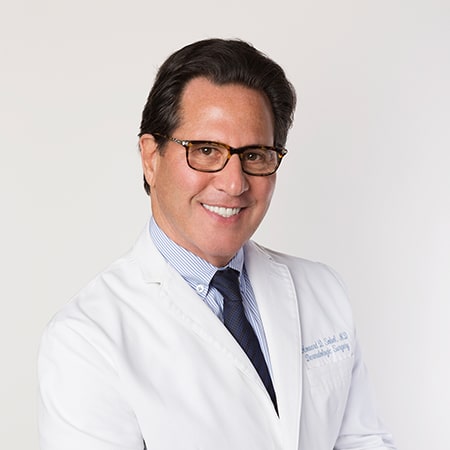
Board-Certified Dermatologic Cosmetic Surgeon · New York Magazine Best Doctor, 21 consecutive years
The Alma TED hair treatment solved the problem that kept a huge number of people from ever addressing their thinning hair: the needles. For years, effective non-surgical hair restoration meant a scalp full of injections. Alma TED changed the equation — a completely needle-free session that patients compare to a warm scalp massage, with zero downtime and results that begin showing within weeks. Here’s how the technology behind hair restoration at Sobel Skin actually works, and who gets the best results from it.

How the Alma TED Hair Treatment Works
TED stands for TransEpidermal Delivery — and the name describes the innovation precisely. The scalp is an excellent barrier; the reason most topical hair products underperform is that almost nothing applied to the surface reaches the follicle where hair growth actually happens.
Alma TED breaks through that barrier without breaking the skin. The device uses ultrasound-based acoustic sound waves combined with air pressure to temporarily open microchannels in the scalp, then drives a concentrated growth-factor and peptide serum down to the follicle level — the depth where injections would otherwise be required. The energy also increases local blood flow, which itself supports follicle health.
The result: injection-level delivery of hair growth compounds, with none of the injection.
What a Session Feels Like
A session takes roughly 20 to 30 minutes. The handpiece glides across the scalp in sections, delivering warmth and a gentle vibrating pressure — genuinely comfortable enough that some patients find it relaxing. There’s no numbing needed, no redness worth mentioning afterward, and no restrictions: you can return to work, exercise the same day, and wash your hair on a normal schedule per your provider’s guidance.
For anyone who has experienced (or avoided) injection-based scalp treatments, the contrast is the entire point.
Alma TED Results: The Realistic Timeline
Weeks 2–4: The first change most patients notice is less hair in the shower drain and the brush — shedding slows.
Weeks 4–8: Early regrowth begins, often first visible as fine new hairs along the part line and temples.
Months 2–3: Density and thickness visibly improve; this is when before/after photos are compared.
Beyond the series: Improvement continues to consolidate for months after the final session.
The standard protocol is three sessions, spaced one month apart, followed by maintenance sessions once or twice a year. Like every non-surgical hair treatment, Alma TED revives struggling follicles — it cannot resurrect follicles that died years ago, which is why the American Academy of Dermatology’s core advice on hair loss applies here too: the earlier treatment starts, the more there is to save.
Who Is the Ideal Alma TED Candidate?
• Early to moderate thinning — the follicles are miniaturizing but alive, and respond best
• Needle-averse patients — the people who researched PRP and never booked it
• Postpartum and stress-related shedding — where follicles are healthy but stuck in a resting phase
• Busy schedules — no downtime means no planning around the treatment
• Men and women equally — pattern thinning in both responds well when caught early
Alma TED vs. PRP: Complementary, Not Competing
Patients often frame this as either/or. In practice, Alma TED and PRP work through complementary mechanisms — PRP delivers your own concentrated platelet growth factors by injection, while Alma TED drives additional growth compounds follicle-deep between sessions without adding more needles. Many of Dr. Sobel’s best hair restoration outcomes come from pairing them, and patients with more advanced thinning may also be evaluated for stem cell hair restoration. For a full side-by-side of all three options, see our complete hair loss treatment comparison.
The point of a medical practice offering the full toolkit: the plan is built around your scalp and stage of loss — not around the one machine a clinic happens to own.
Frequently Asked Questions
Does the Alma TED hair treatment really work?
For the right candidate — early to moderate thinning with viable follicles — yes. Reduced shedding typically appears within the first month, with measurable density improvement across the three-session series. Results depend on starting early and completing the protocol.
How much does Alma TED cost?
Pricing is per session, with packages for the standard three-session series. You’ll receive an exact plan and quote at your consultation after Dr. Sobel’s team evaluates your scalp.
Is Alma TED painful?
No — it’s needle-free, and most patients describe the session as a warm, vibrating scalp massage. No numbing is required.
How is Alma TED different from at-home devices or serums?
Delivery depth. Topicals largely sit on the scalp’s surface; consumer devices lack the power to open transdermal channels. Alma TED’s clinical-grade ultrasound drives growth factors to the follicle level — the depth where treatment actually changes outcomes.
How long do Alma TED results last?
After the initial series, most patients maintain results with one to two sessions per year. Hair loss is a progressive condition, so ongoing maintenance protects the gains.
Start While There’s More to Save
The window where hair restoration works best is the one most people spend “waiting to see if it gets worse.” If you’re seeing more scalp than you used to, book an evaluation with Dr. Howard Sobel‘s team at 960 A Park Avenue. Explore the full hair restoration program, call 212.288.0060, or schedule a consultation online.
Sobel Skin is a premier aesthetic dermatology practice serving the Upper East Side, Manhattan, and the greater New York area.